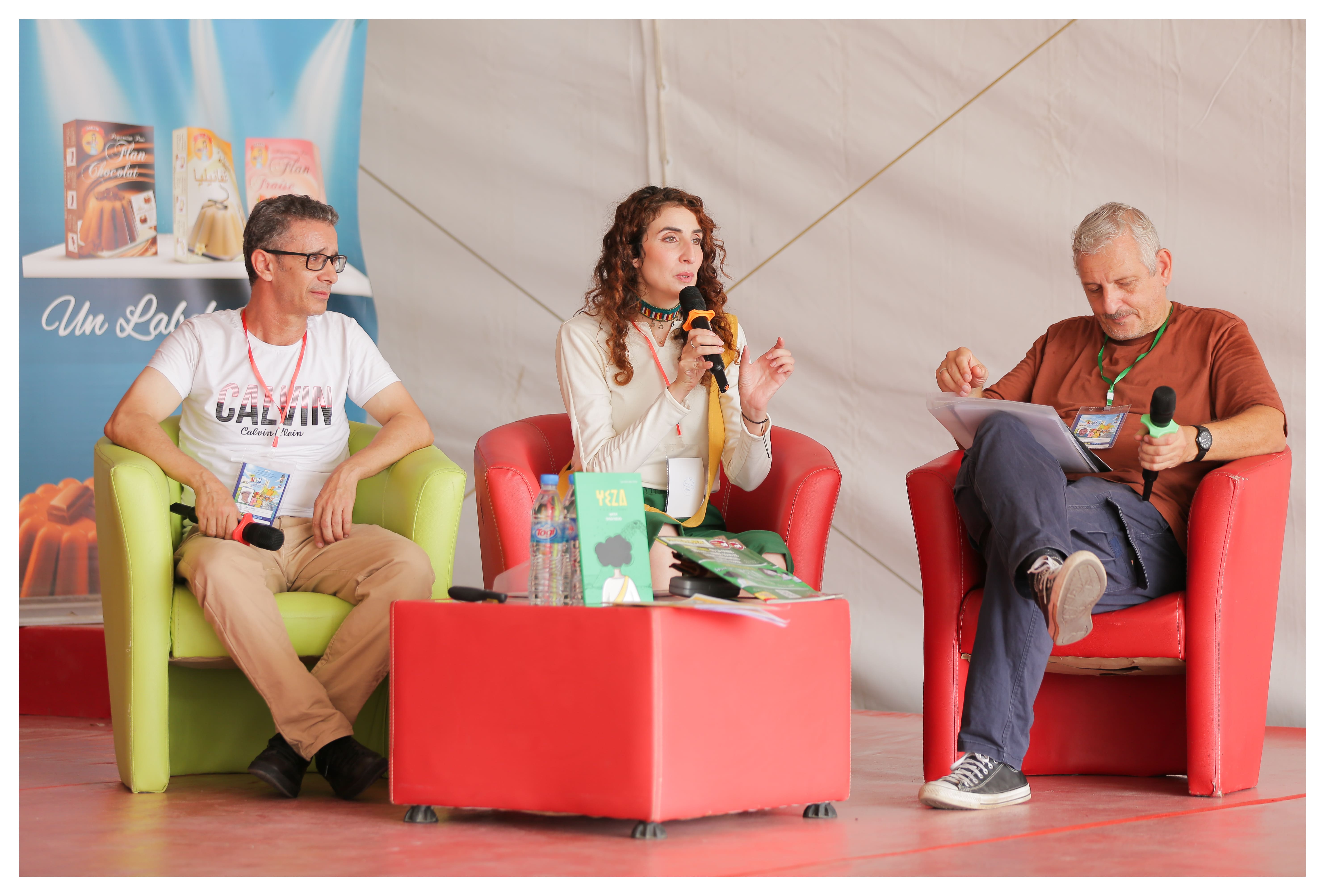
“Dubbed Animated Comics: An Educational Tool for Learning Tamazight. The Case of Nada Dagdoug’s Yeza” was the title of a session held on Friday, October 2, as part of the programme of the 18th edition of FIBDA. During the conference, moderated by Jaoudet Gassouma, Tunisian comic artist Nada Dagdoug and Algerian multidisciplinary artist Omar Sahli presented an original project centred on comics and the learning of Tamazight. The project was born from the meeting of the two creators at FIBDA and seeks to explore the possibilities offered by comics as an educational tool, with digital and audio adaptations.
Nada Dagdoug, whose work notably focuses on comics in the Amazigh language, explained that her work Yeza, created in 2025, was initially designed for children aged nine and above who are beginning to read, whether in French or Arabic. Through the adventures of her character, the artist addresses several issues that children encounter in their daily lives or at school. Ecology, water conservation, renewable energy and waste management, as well as social issues such as immigration and the question of refugees, are all incorporated into the world of the comic.
From Paper to Screen
For Nada Dagdoug, the aim is to turn it into “an educational tool,” she stressed, allowing children to discover a language and a culture through a story, characters and situations that are accessible to them. The work carried out with Omar Sahli now opens up a new stage. Based on four pages from the comic Yeza, the two artists have developed an animated and audio adaptation aimed particularly at younger children, including those who cannot yet read. The principle is to transform the original pages into an audiovisual experience combining animation, voices, music and sound effects. This format is similar to what is commonly known as “motion comics” or animated comics.
Learning Through Movement, Play and Theatre
The project also aims to incorporate movement and play into the learning process. Children could be encouraged to listen, mime the scenes, act out the characters, sing and take part in workshops centred on comics. “We are not only going to do theatre, show the comic, listen, mime, add speech bubbles, move our bodies, but also learn a song that he created,” the artist explained.
Music indeed plays an important role in this approach. The character of Yeza already had a Tunisian song in the first volume, while a new song, entitled “Yeza Tena”, was composed as part of this collaboration. It is intended to be used as a learning aid in workshops for children. The ambition is in particular to develop short video clips that can be broadcast online and used in schools or educational workshops. “We would like there to be several short videos introducing the entire comic,” the artist explained.
Giving the Comic a Voice
Omar Sahli, for his part, explained that the collaboration grew out of exchanges at a distance and a shared reflection on how to take comics towards other forms of storytelling. “It started with just the song,” he recalled. The first experiments then focused on four pages of the comic, which were sent by email so that the work could begin remotely.
For him, the approach is also connected to a childhood memory. When he read comics, he would spontaneously imagine voices for the characters. From this memory came the idea of recreating a soundscape that would allow people to “listen to” a comic. The method draws in particular on radio theatre, to which music and sound effects are added. Each graphic element can thus be translated into sound. “Every graphic element is a language,” Omar Sahli explained.
The adaptation also involves reworking the visual composition. Panels, speech bubbles and the various graphic elements are separated and then reassembled to create transitions between scenes. The artist refers to this as “graphic rearrangement”, which consists of introducing new elements and adapting the images to the rhythm of the narrative.
Music and Sound as Educational Tools
This approach is accompanied by substantial musical work. Omar Sahli explained that he wanted to create a distinct sound identity for the characters and the different situations. The music can therefore be rearranged according to the context while retaining the same melodic identity. “Music is a language,” he recalled, stressing that the same theme can be interpreted in different ways depending on the situation.
In the case of Yeza, the song from the first volume can therefore exist in several arrangements, including versions featuring different instruments or piano. According to him, this sound dimension is one of the distinctive features of the approach. He also referred to the idea of a “musical identity” associated with the characters, an idea reminiscent of the leitmotif principle used in music, particularly in cinema.
The artists aim to develop a genuine learning tool that engages several senses: sight, hearing, movement and collective participation.
The question of distribution was also addressed during the session. One production is already available on YouTube, and the project has also been presented in schools as part of workshops. The experience could therefore continue with new clips and adaptations.
The comic Yeza thus becomes a starting point for a broader experience at the crossroads of image, sound, music and education, with the ambition of fostering children’s interest in reading while familiarising them with the Amazigh language and culture.